
The Baltic–Adriatic Axis
How Central and Eastern Europe Is Emerging as a Strategic System

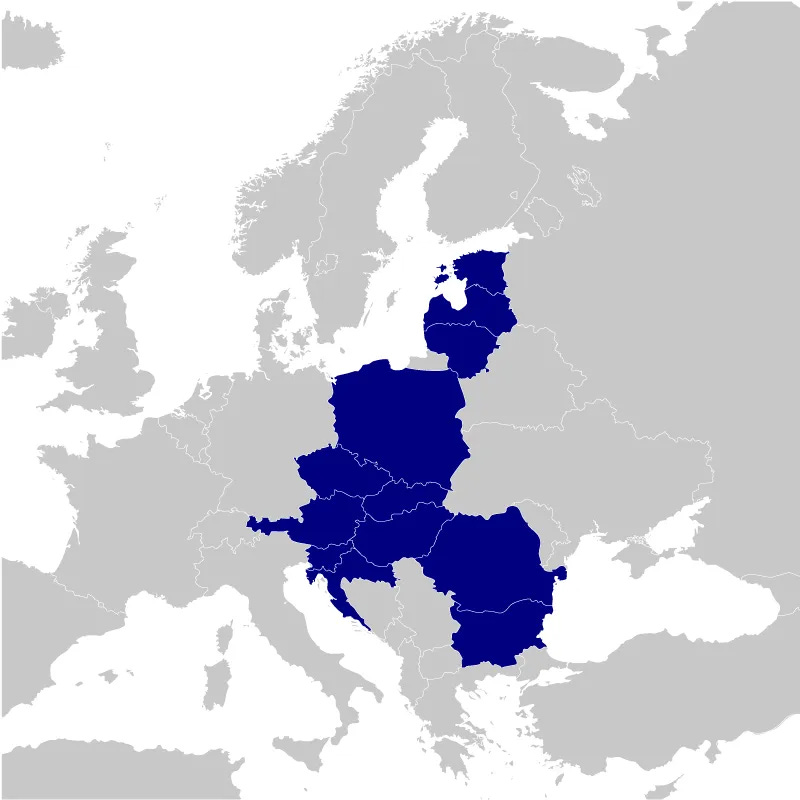
Introduction
For thirty years, Central Europe was a space to be integrated; today, it is a space that integrates.
This shift marks the end of the post–Cold War order. In my previous analysis of the Nordics as a security cluster, I argued that Europe is becoming increasingly polycentric and no longer defined by a single Western core, but by multiple functional centers. Central Europe is the next decisive piece in this new geopolitical geometry.
This space is no longer just an in-between zone. It has turned into a pressure chamber. Historically, the classic Zwischeneuropa was the arena where the Habsburg, Ottoman, and Russian empires collided. Today, under renewed geopolitical pressure and systemic competition, a new structural logic is taking shape: the Baltic–Adriatic axis.
This north–south alignment breaks with the traditional west–east orientation of the 20th century. What defines the region now is not the absence of sovereignty, but the intensity of constraint. Limited strategic depth and the concentration of key access points across three seas force interaction.
Geography does not determine outcomes, but under pressure, it enforces coordination.
The Vertical Spine
The region’s growing coordination is no longer a political fiction, but an emerging structural reality. Central and Eastern Europe is no longer waiting for integration; it is driving it.
This is most evident in the way the region is closing functional gaps left by decades of East-West alignment. Initiatives such as the Three Seas Initiative (3SI) are far more than diplomatic forums; they are the blueprints for a new European vertical spine. When Poland and Croatia connect their gas networks via interconnectors, they are not only integrating energy markets but are creating a geopolitical insurance policy against external blackmail.
Projects such as Neptun Deep in the Black Sea are transforming this vertical integration from a logistical necessity into a strategic reality. When Romania becomes the EU’s largest natural gas producer starting in 2027, it will shift the balance of power across the entire continent. Neptun Deep is not merely a Romanian energy project; it is the fuel for regional autonomy.
In combination with the LNG terminals in Świnoujście and Krk, a closed system is emerging that will finally break the dependence on east-west pipeline structures. Gas from the Black Sea provides the necessary base load to stabilize the industrial base in countries such as the Czech Republic, Slovakia, and Hungary, while the northern and southern ports ensure connectivity to the global market. Here, the geography of the Black Sea, once a Russian sea, is redefined as an integral part of Europe’s energy security.
This functional integration now extends significantly to Ukraine. While Western Europe debates the legal hurdles of EU accession, CEE is carrying out de facto integration on the ground. It is the railways, the repair hubs for Western weapon systems in Poland and Romania, and the synchronization of power grids that are pulling Ukraine irreversibly into the European orbit. The geographical space functions as the operational engine that is reassembling the continent.
What is emerging here is not a classical aligned bloc, but a system of overlapping functions. Coordination does not require ideological unity; it arises from the interaction of differentiated roles that, under the pressure of necessity, merge into a coherent whole.
A System of Specialized Nodes
The new vertical backbone is a network of specialized nodes. In this system, a state’s role is defined by function, not size. The result is a functional division of labor that transforms geographical constraints into strategic advantages.
Poland as the kinetic center: Through massive investments in conventional capabilities — including hundreds of South Korean K2 tanks and K9 howitzers — Warsaw is positioning itself as the region’s primary military anchor.
Poland provides the mass and strategic depth that others lack. It is the heavy lifter of NATO’s eastern flank.
The Baltic States as digital sensors: Lacking strategic depth, Estonia, Latvia, and Lithuania have shifted their defense toward the cyber and information domain.
They function as an early warning layer for the wider system. Their integration of society into total defense concepts makes them a prototype for modern hybrid warfare.
Romania as an energy anchor: Through projects such as Neptun Deep in the Black Sea, Romania is evolving into a regional energy provider.
It supplies the base-load energy that supports the industrial backbone of landlocked states such as the Czech Republic, Slovakia, and Hungary, reducing vulnerability to external pressure.
Croatia as a maritime hub: With the LNG terminal on Krk and its position on the Adriatic, Croatia secures the system’s access to global energy flows.
It functions as a logistical gateway linking Central Europe to maritime routes.
The Czech Republic as an industrial heart: With its industrial base and role in defense production, the Czech Republic provides the material backbone for regional resilience.
It underpins the system’s capacity to sustain prolonged pressure.
This division of roles is not designed; it is imposed by structural pressure. As strategic depth shrinks and external pressure increases, no state can afford full-spectrum autonomy. Specialization becomes essential, creating an interconnected system.
Fragility and The Limits of Cooperation
Despite growing coordination, Central and Eastern Europe remains shaped by divergent strategic priorities, historical tensions, and competing political paths. These frictions do not vanish under external pressure; they persist and often intensify.
Political differences impose structural limits on the region’s cohesion.
Hungary is the most visible example. Its repeated clashes with Brussels over the rule of law and foreign policy repeatedly test the limits of European alignment. Yet, Hungary does not break the system; it reveals its limits. Its emphasis on national sovereignty is both an obstacle to deeper cooperation and, simultaneously, the very reason these states cooperate in the first place. For countries in this region, joining the EU or NATO was never about giving up sovereignty. It was about strengthening it under new conditions.
That means, cooperation is accepted only as long as it serves national sovereignty, not when it begins to erode it. That is the fundamental difference between East and West.
Historical rivalries further complicate this picture. For example, the historical Romanian-Hungarian quarrels over issues like minority rights, energy policy, or historical narratives. At the same time, strategic orientations diverge. Poland focuses on deterring the eastern threat while maintaining strong transatlantic ties; Hungary is more flexible, at times accommodating Russia.
For this reason, alignment in the region remains situational, not structural. Cooperation increases when immediate security interests overlap, but it fragments as soon as national priorities or historical sensitivities reassert themselves.
The region’s strength lies in its adaptability, but this adaptability also defines its limits.
The Question of Social Continuity
Societal dynamics form an additional layer of the region’s strategic development.
Beneath the level of hard security, another important development is taking shape. While Western Europe has largely tried to solve its demographic decline through migration, several countries in Central and Eastern Europe are testing a different approach: strengthening internal cohesion and demographic continuity.
Poland and Hungary have introduced extensive family policies with substantial financial incentives. Croatia has focused heavily on diaspora engagement, trying to bring its own people back as a source of continuity. These efforts are not just social policy.
They represent a strategic attempt to maintain societal resilience without relying primarily on external population influx. The logic behind this is: in an era of long-term demographic pressure, social cohesion can itself become a strategic asset. High institutional trust and a sense of shared identity can make societies more willing to accept the costs of defense and stability.
However, these strategies are young and unproven. Their long-term success depends on many factors. It’s uncertain whether they can deliver sustainable results or if they will need to be supplemented by other measures.
This approach is not a finished model, but rather an experiment to preserve societal continuity in an increasingly competitive and open environment. This path’s ability to withstand challenges remains one of the central open questions for Europe’s future.
Growth vs. Power
Economic growth in Central and Eastern Europe has outpaced its translation into strategic power. Central and Eastern Europe has often outperformed “old Europe” economically. But growth alone does not equate to power.
The region is rising in relative terms, but it is not replacing the Western core. Three structural constraints continue to limit the conversion of economic dynamism into genuine strategic influence:
First, the capital and technology gap. Despite strong growth, CEE remains a net importer of capital and high-end technology. Its industrial base is still deeply embedded in Western supply chains.
Second, security dependency. The eastern flank has become far more important for NATO, but it continues to rely heavily on the American security guarantee.
Third, institutional weight. In Brussels, real influence still flows through long-established networks and continuity. CEE is only beginning to translate its economic gains into personnel and agenda-setting power.
Yet here lies a striking paradox. Precisely because of its exposed position and strong support from the United States, Central and Eastern Europe is developing a form of practical sovereignty that much of Western Europe has largely lost.
Poland, the Baltics, and Romania are spending far higher shares of GDP on defense than Germany or France. Their populations show a much greater willingness to bear the costs of security. Also, national sovereignty is not treated as a problem to be managed in Brussels, but as a core political value to be defended.
The result is an asymmetry that goes beyond simple dependence: the region has become indispensable for Europe’s stability, but it is also becoming more autonomous in its willingness to act.
It is an emerging pole but not (yet) a new center of gravity. The direction is visible. The outcome remains uncertain.
Conclusion: From Gravity to Polycentrism
In my essay, “Europe’s New Center of Gravity,” I argued that the continent’s political center of gravity is shifting eastward. This essay refines that claim: the shift is not simply geographic, it is structural.
Central and Eastern Europe is no longer a passive space of integration, but an active strategic system within an increasingly polycentric Europe.
This “New Europe” is neither a bloc nor a replacement for the West. Its strength lies in coordination across the Baltic, Adriatic, and Black Seas.
Its limitations remain equally clear: political fragmentation, divergent strategic cultures, and continued dependence on external security guarantees constrain its ability to act as a fully autonomous power center.
Yet the path is unmistakable. The era in which Central and Eastern Europe functioned primarily as the object of external influence is coming to an end.
In a Europe increasingly defined by multiple functional centers, including the Nordics and the Western core, CEE is emerging as the integrating space between them.
It does not yet replace the center of gravity.
It redistributes it on its own terms.
Selected Reading
Three Seas Initiative, Official Project Portfolio
Atlantic Council, The Three Seas Initiative stands at an Inflection Point
European Commission/industry reports on Neptun Deep and regional energy integration
Robert D. Kaplan, The Revenge of Geography
Zbigniew Brzeziński, The Grand Chessboard
Halford J. Mackinder, Democratic Ideals and Reality
Nicholas J. Spykman, The Geography of the Peace
Thank you for this article, and also for including Romania's Neptun Deep project that not a lot of people know about. A great lesson in energy and regional industry.
I found the idea that geography enforces coordination under pressure really interesting. Historically though, similar pressures have often produced conflict instead. I'm curious - what do you think determines which way it resolves in cases like this?